
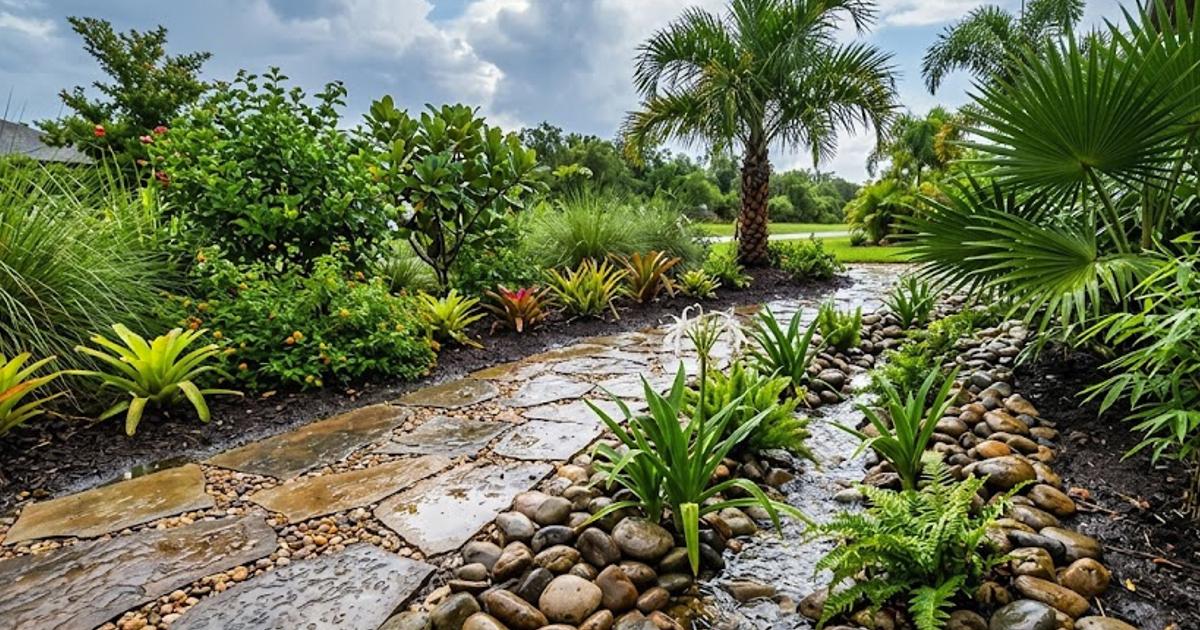

In Southwest Florida, rainfall is not just a seasonal pattern—it is a defining force that shapes how landscapes behave, evolve, and sometimes fail. Intense downpours, saturated soils, and rapid drainage changes can stress even well-designed outdoor spaces. The difference between a landscape that struggles and one that recovers quickly often comes down to how it was designed long before the rain ever arrives.
At Rise Landcare, resilience is not treated as an afterthought. It is built into the structure of the landscape itself. When a property is designed with recovery in mind, heavy rainfall becomes a temporary condition rather than a long-term disruption.
Rainfall Doesn’t Damage Landscapes—Poor Design Does
Many landscape issues that appear after heavy rain are not caused by the storm itself, but by how water is managed on the property. When drainage, grading, and soil structure are not properly considered, water lingers too long in areas that were never meant to hold it.
Common post-rain issues include:
- Standing water in low-traffic zones
- Soil erosion around planting beds
- Declining plant health due to oversaturation
- Compacted areas that drain unevenly over time
A resilient landscape anticipates these conditions instead of reacting to them.
Recovery-Focused Design Starts Below the Surface
The ability of a landscape to recover quickly after rainfall begins with what most people never see: soil composition, grading strategy, and subsurface water movement. These foundational elements determine how quickly excess water is absorbed, redirected, or released.
Key factors that support faster recovery include:
- Proper soil structure that encourages drainage
- Grading that directs water away from critical zones
- Root systems that stabilize soil during saturation
- Strategic use of permeable landscape materials
When these systems work together, water becomes part of the cycle instead of a source of damage.
Plant Selection Plays a Major Role in Post-Rain Resilience
Not all plants respond the same way to heavy rainfall. Some thrive in fluctuating moisture conditions, while others decline quickly when roots remain saturated. Choosing the right plant palette is essential for maintaining both beauty and stability after storms.
Resilient landscapes often include:
- Native or adaptive plant species suited to local rainfall patterns
- Deep-rooted vegetation that stabilizes soil
- Layered plantings that reduce surface erosion
- Strategic spacing that improves airflow and drying time
The right plant choices help the landscape reset faster after weather events.
Water Movement Should Be Visible and Intentional
One of the most overlooked aspects of resilient landscape design is how water moves across the property. When water flow is uncontrolled or invisible, it often collects in unintended areas and creates long-term damage.
Intentional water movement can be achieved through:
- Subtle grading transitions that guide runoff
- Natural swales that slow and filter water
- Hardscape elements designed for drainage support
- Landscape contours that distribute moisture evenly
When water has a clear path, recovery becomes predictable instead of problematic.
The Goal Is Not to Resist Rain, But to Work With It
In Southwest Florida, rainfall will always be part of the environment. The most successful landscapes are not the ones that try to eliminate its impact, but the ones that integrate it into their design strategy. When landscapes are built to handle water naturally, they recover faster, last longer, and require less intervention over time.
A well-designed outdoor space doesn’t just survive heavy rainfall—it resets, restores, and continues functioning as intended. That is the difference between reacting to weather and designing for it from the beginning.